
When it comes to choosing an IB Economics tuition provider in Singapore, it’s more than just choosing a tutor. A good economics tutor can help students grasp complex economic concepts, tackle IBDP exam questions effectively, and build confidence.
In terms of resources, study materials, teaching methods, the cost-to-value ratio of tuition fees, and support for SL and HL students, there are many different ways an economics tutor can approach teaching their students. The main way an economics tutor would approach delivering economics information to their students is in an organised manner. Other economics tutors may even hold extra classes in order to give individual attention to their students. Some economics tutors even go so far as to provide support outside of lessons to ensure that their students are able to gain the best possible grades for IBDP Economics exams.
The following are the aspects to consider when choosing the best IB Economics tuition providers in Singapore.
Tutor Expertise and Experience
Knowing economics in general is not the same as knowing IB Economics inside out. The syllabus can be a beast, and questions can be tricky. A tutor with solid IB experience — someone who’s actually graded papers, spotted recurring exam traps, or helped students achieve 7s consistently — may give you an edge.
Pay particular attention to Standard Level versus Higher Level experience. SL covers the core units in roughly 150 teaching hours and focuses on Papers 1 and 2 plus the Internal Assessment. HL adds significant depth, quantitative extensions, and Paper 3, running to about 240 hours (IB Economics subject brief).
A tutor with practical experience will understand where you need to pay more attention and adjust time spent accordingly. Don’t hesitate to ask about their track record, but make sure you choose a specialist who knows the syllabus and can translate it without sounding like a textbook.
Teaching Style and Approach
It is a fact that all students have different learning styles. Some prefer a more drill-based approach such as going through past exam papers until they can memorise every single word and concept. Other students are purely surface learners who need every concept fully explained with real-life examples to understand.
Although it is rare to find a tutor who can accommodate all of a student’s learning styles, the tutor usually teaches in a style that best suits the tutor’s own learning style. Towards the end of the two-year course, even more emphasis should be placed on exam technique, i.e. command terms, structured evaluation, data-response and timed essays for both SL and HL students.
If you’re an HL student, you should start learning quantitative and analytical techniques early for Paper 3 and to perfect your drafts for the Internal Assessment. Furthermore, practising writing essays within the given time frame is crucial.
Class Size and Personal Attention
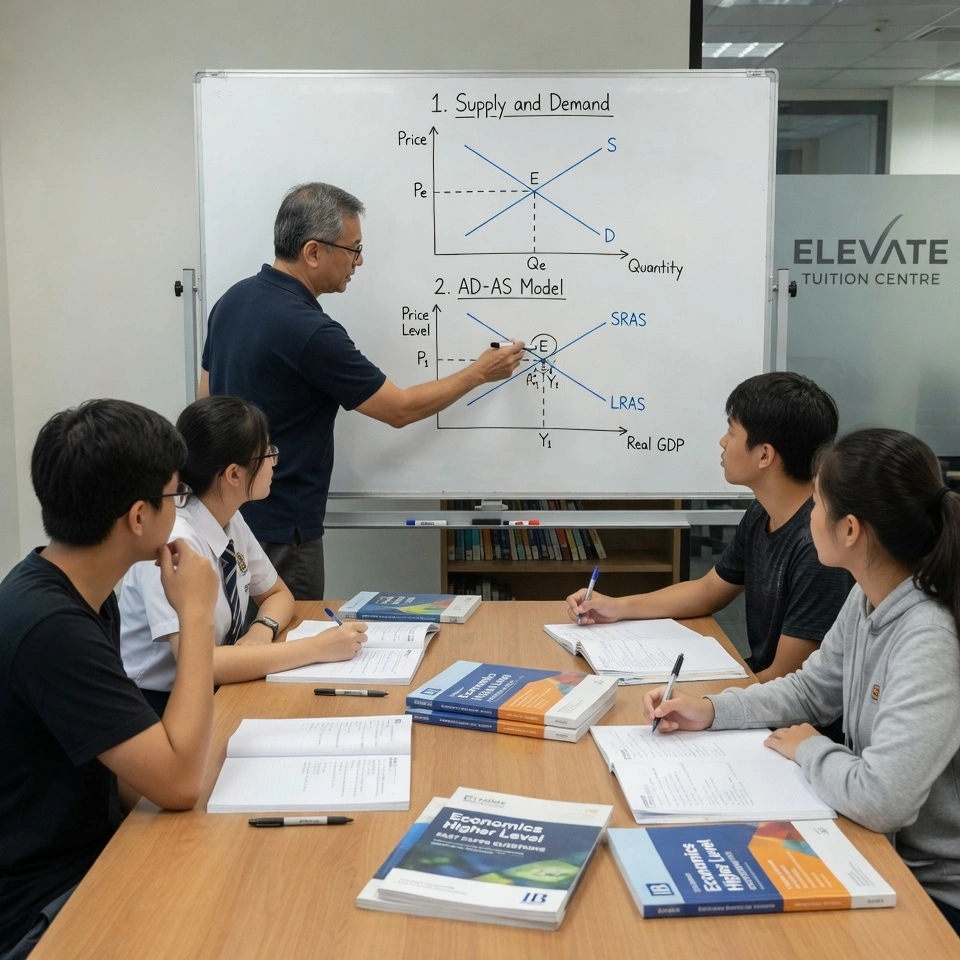
Class size has a direct impact on how much individual attention a student receives. Many students struggle to grasp concepts such as elasticity or opportunity cost. For many HL students, there is a lot of quantitative work in their Economics studies. That’s why they need to be in a smaller class, or even have one-on-one sessions.
As mentioned earlier, the cost for a group class of IB Economics tuition in Singapore would typically range from S$50 per hour to S$120 per hour. For a private or one-on-one class of HL Economics tuition in Singapore, the cost would typically range from S$80 per hour to S$180 per hour. What is more important than cost is what one is paying for.
For example, is the tutor including marked-up essays for the student’s Internal Assessment or written-up essays for Paper 2 in his/her fees? Are there sufficient resources provided for the student, such as worksheets, past papers, etc.? Most importantly, is there sufficient personalised feedback provided for the student’s level (SL or HL)? If not, then even though the large class may be cheaper, it would end up being more expensive than the higher-fee small group in the long run.
Flexibility and Scheduling
As an IB student, you have many commitments in school (other subjects), as well as other activities (clubs, CCA, sports, hobbies) outside of school. This may include some activities on the weekends. In addition, some students have family commitments. So, having fixed timing of tuition sessions (say every week on Monday at 4 pm) may not be suitable. Ideally, a tutor should have some flexibility to schedule sessions to catch up with you. Also, a tutor may schedule extra sessions to address situations like these, for example, to explain material that was not fully covered in class.
Resources and Support Materials
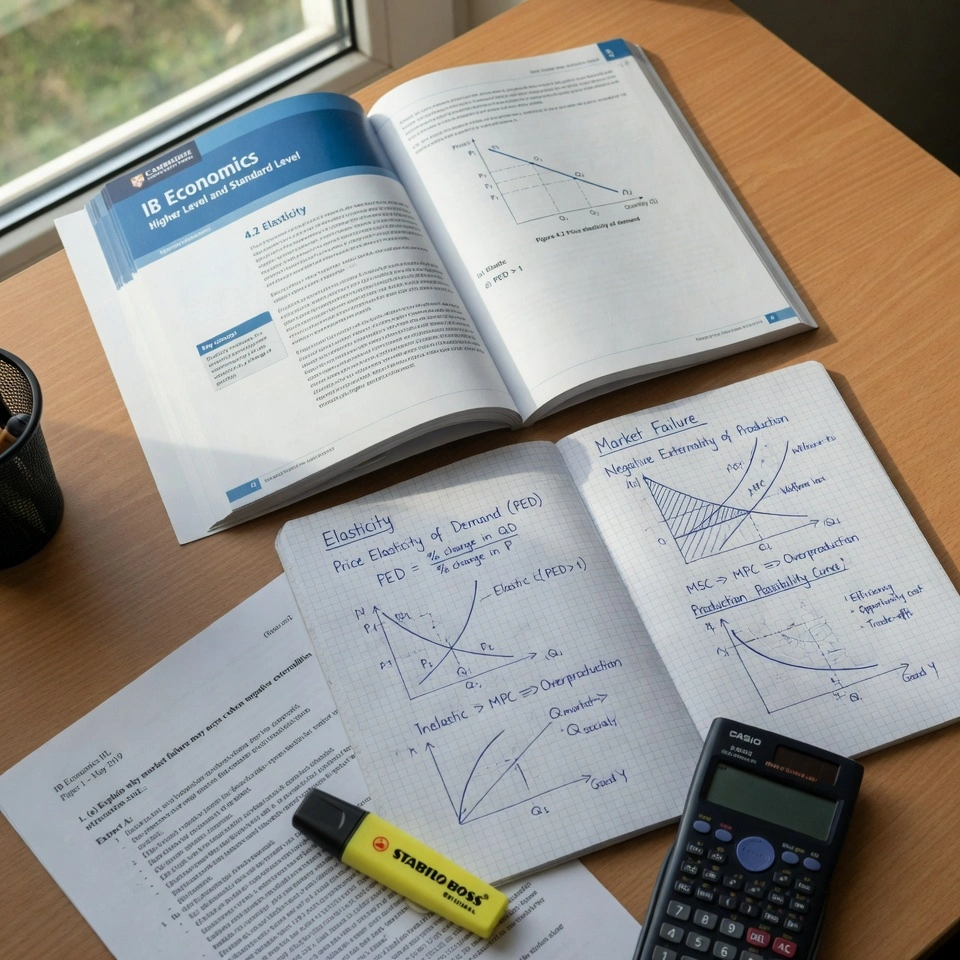
On the one hand, some tutors would simply go through the economics textbook with their students. On the other hand, some tutors would provide their students with extra study materials such as summaries of key points, model answers to past exam questions, and practice questions for data-response questions. This would save students a lot of time as they would not have to browse through the textbook and then go through lots of past exam papers to figure out the important points to study for.
The resources should differ between SL and HL students to accommodate the level of difficulty for each paper. A tutor should focus on helping their students understand key concepts and apply what they have learned in class to the exam papers. There are some tuition centres where the resources can be excessive for some students.
Some students have loads of resources and don’t know where to start, which can result in a lot of unnecessary work and less time to actually understand and complete their exam study. As a parent, you should check the amount of resources that your child will receive and whether they will be able to complete all of the study with the resources that they have. It is also important to check whether marked practice and feedback are included in the tuition fee or if it is an additional cost.
Reviews, Testimonials, and Word of Mouth
There are also lots of reviews and testimonials of past students and their parents that you can read when looking for tutors or tuition centres. These are great to read because they give you an idea of the tutor’s teaching style and how they might be able to help you.
Note that because everyone learns differently, there will probably be some reviews that are written by people who are very different from you, so try to look for reviews that mention specific points that you are struggling with, and then check to see if the tutor is able to explain these points clearly. If lots of students say that the tutor is great for explaining one particular tricky topic, for example, then it is more likely to be true for you too.
Trial Sessions and Comfort Level
Finally, trust your gut. Many tuition centres offer trial sessions. Take them. Sit through a lesson and see if it works for you. Ask yourself:
- Can I follow the explanations?
- Do I feel comfortable asking questions?
- Does the tutor notice when I’m struggling?
- Can they adjust for SL versus HL demands or shift between concepts and exam technique as needed?
Comfort level is underrated. You could have the most qualified tutor in Singapore, but if the vibe doesn’t click, progress may be slow. A tutor who is patient, approachable, and notices your stumbling blocks can make learning feel less like punishment and more like actual growth.
Conclusion
Choosing the right IB Economics tuition in Singapore isn’t just about flashy credentials or fancy ads. It’s about the subtle mix of expertise, teaching style, class size, flexibility, resources, credibility, comfort level — and a clear-eyed view of cost versus value. Typical group rates often land in the S$50–120 per hour range and private tuition higher, but the real question is what you receive for the fee.
A tutor who matches your needs may boost not just your grades, but your confidence, your curiosity, and maybe even your enjoyment of economics. Take your time, do the research, ask about SL/HL differentiation and what is included in the fee, and don’t be afraid to try a session or two before committing. Tuition isn’t magic, but the right guidance in IB economics can turn that abstract jumble of graphs and theories into something you actually understand — and maybe even like.