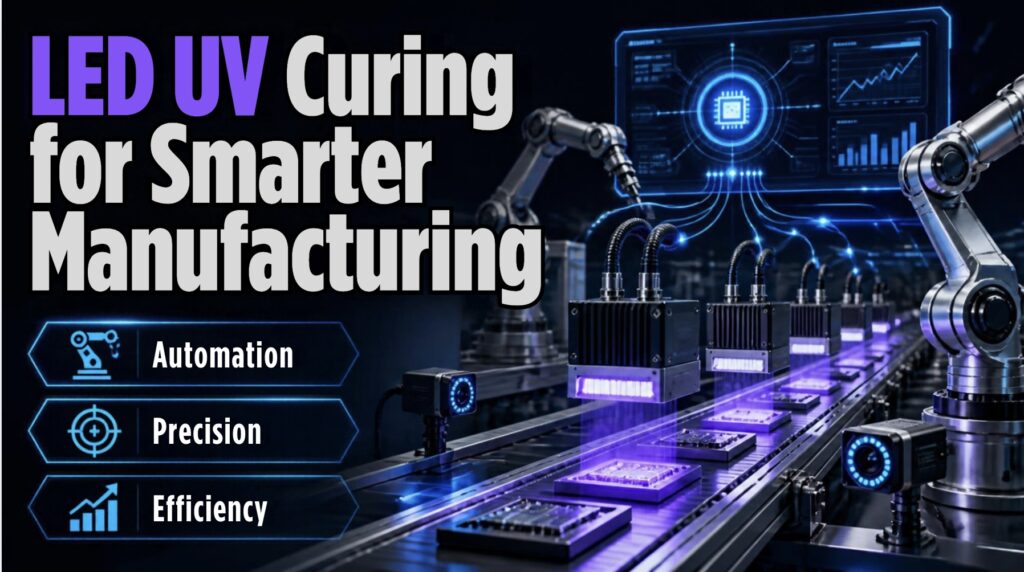
Automation has become an integral part of contemporary manufacturing. As requirements for production keep rising, manufacturers look not only for machines that operate faster but also for production lines that will provide increased precision, accuracy, and efficiency.
Each step of the manufacturing process should now lead to increased productivity along with adherence to certain quality standards. One of the spheres in which this revolution takes place is curing. In today’s manufacturing, curing can be considered an integrated part of the production process.
By using LED UV curing in combination with automation, manufacturers can achieve more efficient production processes and eliminate any unnecessary delay.
Whether the manufacturer produces electronic components, medical equipment, automotive parts, or precision-engineered items, the use of LED UV curing in automated production lines allows manufacturers to guarantee dependable and predictable manufacturing results.
Why Automation Has Become Essential in Modern Manufacturing
Production processes nowadays involve much more than just production volume. Businesses need to produce high-quality products within shorter time periods, more efficiently, all at an affordable price point and according to the current market needs.
In order to stay ahead of their competitors, many manufacturers opt for automating their production processes. This involves the following goals:
Producing more with improved consistency.
- Decreasing manual intervention during the entire manufacturing process.
- Improving quality of the manufactured products with the help of repeating production cycles.
- Decreasing downtime and inefficiencies of the manufacturing process.
- Creating scalable manufacturing processes in case of increased production demand.
The more production processes become automated, the more important the accompanying technologies become. One of them is LED UV curing technology.
Where LED UV Curing Fits Within an Automated Production Line
Automation can be done effectively only if all the steps in the production process run as a system. Each step cannot run on its own but should run smoothly with the other step in production.
A simplified automated workflow may look like this:
Component Placement
↓
Adhesive or Coating Application
↓
LED UV Curing
↓
Quality Inspection
↓
Assembly or Packaging
In this process, LED UV curing allows for quick and immediate curing of adhesives, coatings, or inks once they have been applied. This instantaneous curing means that there is no need to wait during production, thus ensuring an efficient manufacturing process.
Why LED UV Technology Works Well in Automated Systems
The application of LED UV curing systems enhances the effectiveness of automatic manufacturing due to compatibility between the process parameters of LED UV curing and requirements in contemporary manufacturing environments.
Instant Operation
LED UV systems quickly reach their full operating intensity. In this way, the production line may be easily turned on or off without the need to wait until the lamp gets warm.
Consistent Process Control
Maintaining consistent curing conditions is essential to ensure repeatable manufacturing results that are especially critical in cases of precision manufacturing.
Reduced Heat Exposure
The low heat generation associated with LED UV curing helps to make LED UV suitable for manufacturing processes that use temperature-sensitive materials. This helps to protect delicate components while maintaining production efficiency.
Lower Maintenance Requirements
As compared to other forms of UV lamps, LED UV curing requires less maintenance and thus allows increased production efficiency.
How Different Industries Benefit from Automated LED UV Curing
Manufacturing processes each have unique production needs, but the common objective is always to attain high-quality results as well as increased efficiency in the process. Due to the fact that LED UV curing technology can be applied to different production conditions, it works for many manufacturers in various sectors.
Electronics Manufacturing
Electronics manufacturing entails assembling small and sensitive parts. With the help of automated LED UV curing technology, adhesives and coating materials dry fast without exposure to heat, ensuring high-quality results and efficient production process.
Medical Device Manufacturing
When it comes to manufacturing medical devices, there is a need for manufacturers to have repeatable production processes in line with the stringent quality requirements. The use of LED UV curing technology in an automated assembly line enables the achievement of repeatable curing of specific adhesives and coatings.
Automotive Manufacturing
The trend in the automotive industry towards electronic control systems and lightweight components means that the need for high-speed but accurate manufacturing processes is on the rise.
Precision Engineering and Industrial Manufacturing
Whether you’re dealing with optical parts or any other type of engineered product, chances are you’ll need some kind of curing. In order to ensure the right result is achieved every time, automation combined with LED UV will do the trick.
Planning a Successful LED UV Integration
Implementing LED UV curing into an automated manufacturing process is not just about purchasing new technology. The manufacturers need to think about whether the technology suits their current production process.
Before implementation, it is helpful to consider:
- The type of materials, adhesives, or coatings being used.
- Required production speed and throughput.
- Available space within the production line.
- Compatibility with existing automation equipment.
- Future production requirements and scalability.
The process of careful planning enables the manufacturer to implement the LED UV curing technology in their manufacturing processes without any difficulties and also to achieve long-term efficiency.
Looking Ahead: Automation and the Future of Manufacturing
Manufacturing continues to evolve as businesses increasingly want to have smart ways of improving efficiency, cutting down on waste, and maintaining quality standards of products. Automation will definitely be one of the driving forces behind this revolution, but its success will hinge on how effectively each and every step in the manufacturing process is integrated.
LED UV curing has played a significant role in this revolution by helping to achieve faster and more reliable curing during automation in production lines. This process of integration of LED UV curing into automated production can help manufacturers design production systems that not only function more efficiently but also prepare for future manufacturing requirements.