
When you search for the right data analytics consultant in Singapore to support your next project or business transformation, your search will lead to a decision that can shape up your project or even change the direction of your business. The market of data analytics consultants in Singapore is filled with firms and individual experts with high capability and high-quality talent. But somehow, when it comes to selecting the right one, it’s all down to circumstance. Here at Data Consulting Asia, we don’t think that has to be the case. We believe there is a more practical criterion that you can use when selecting the right data analytics consultant for your organisation.
This practical guide does not aim to list and compare every data analytics company and consultant in Singapore. Nor do we intend to go into the in-depth theories behind data analytics. What this guide intends to do is equip the reader with the necessary criteria to objectively evaluate data analytics consultants and identify the right one for the job. Before we look at how to compare consultants or shortlist companies, it is worth first laying out the key decisions a buyer needs to make to pick the right person for the job. Poor analytics projects typically fail not because of poor-quality tools or the individual analyst, but because the wrong set of questions was asked at the very start.
What should you realistically expect from an analytics consulting partner?
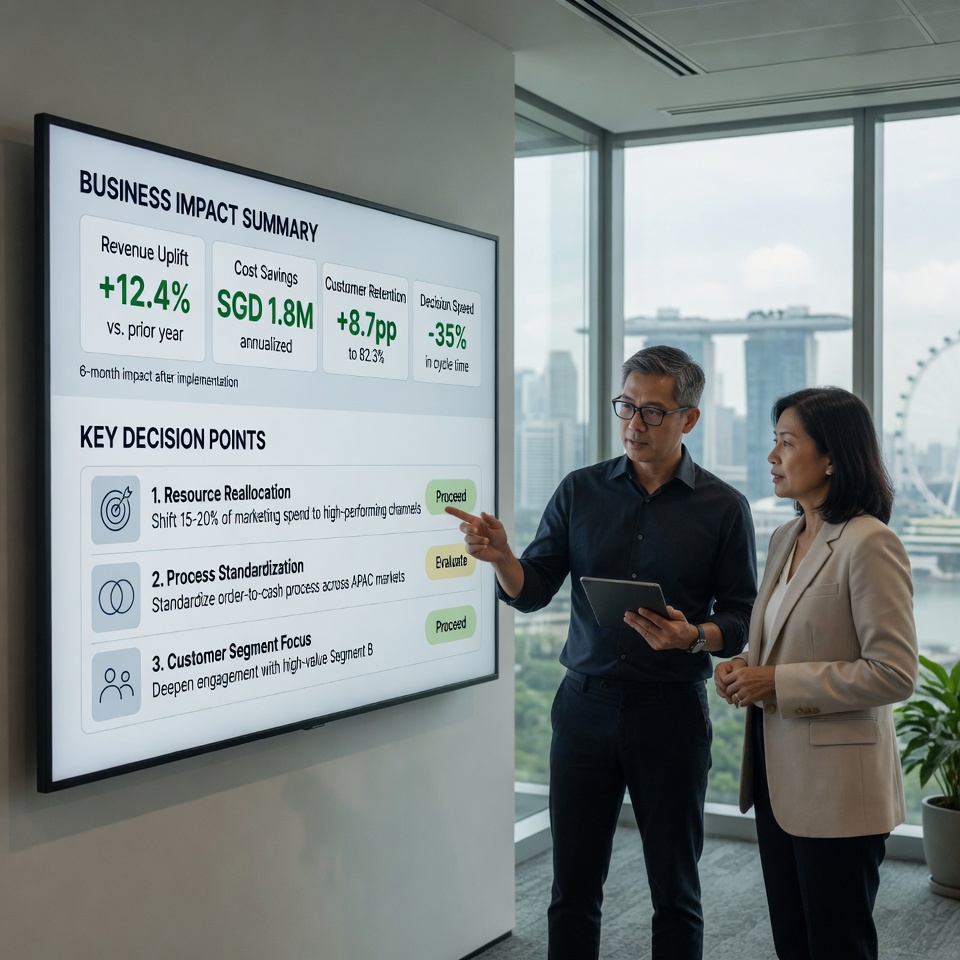
In the first few meetings, the consulting team should spend more time asking uncomfortable questions than showing slides. Questions about how decisions are made today, where numbers are being challenged, and what “success” actually looks like for your leadership team.
From there, expectations need to shift away from technical outputs. Business leaders shouldn’t be handed model accuracy scores or tool comparisons. What matters more is clarity: Which decisions will improve? Who will act on the insights? What changes if the data is right?
One rule we often share is this — a deliverable that doesn’t change behaviour is not finished. Most importantly, outcomes and ROI should be defined before any platform or architecture is discussed. Tools are easy to buy. Aligning analytics to measurable business impact is the real work. And that alignment should be explicit from day one.
How do you evaluate whether a data analytics consultant actually understands your industry?
Here’s the uncomfortable truth: most analytics failures aren’t technical. They’re behavioural. If a consultant doesn’t acknowledge that early, the rest of the engagement is usually cosmetic.
Why generic analytics frameworks often fail in sector-specific environments
On paper, most analytics frameworks look solid. The problem is context. And that’s usually where things start to drift.
A churn model designed for SaaS rarely maps cleanly to manufacturing downtime or facilities management performance.
We’ve seen projects stall even when the underlying analysis was technically sound. In one Singapore-based facilities management firm, the model was accurate, but adoption failed because supervisors were still incentivised on manual reporting speed—not forecast quality.
What “industry-vertical expertise” looks like in practice (signals to look for)
Real industry understanding shows up early. A professional data analytics consultant in Singapore won’t start by asking what tools you use. They’ll ask about operational constraints, regulatory pressures, and where frontline teams lose time today.
Look for consultants who reference familiar KPIs without prompting, challenge assumptions respectfully, and explain trade-offs using examples from similar environments. Not generic case studies.
How industry knowledge reduces implementation risk and accelerates adoption
Consultants who know your sector anticipate data quality issues, change resistance, and reporting realities before they surface. That reduces rework and speeds adoption.
A simple test: ask how they’d adapt their approach if adoption lags. Experience-based answers come quickly. Generic ones don’t.
What evaluation criteria matter most when selecting an analytics consulting partner?
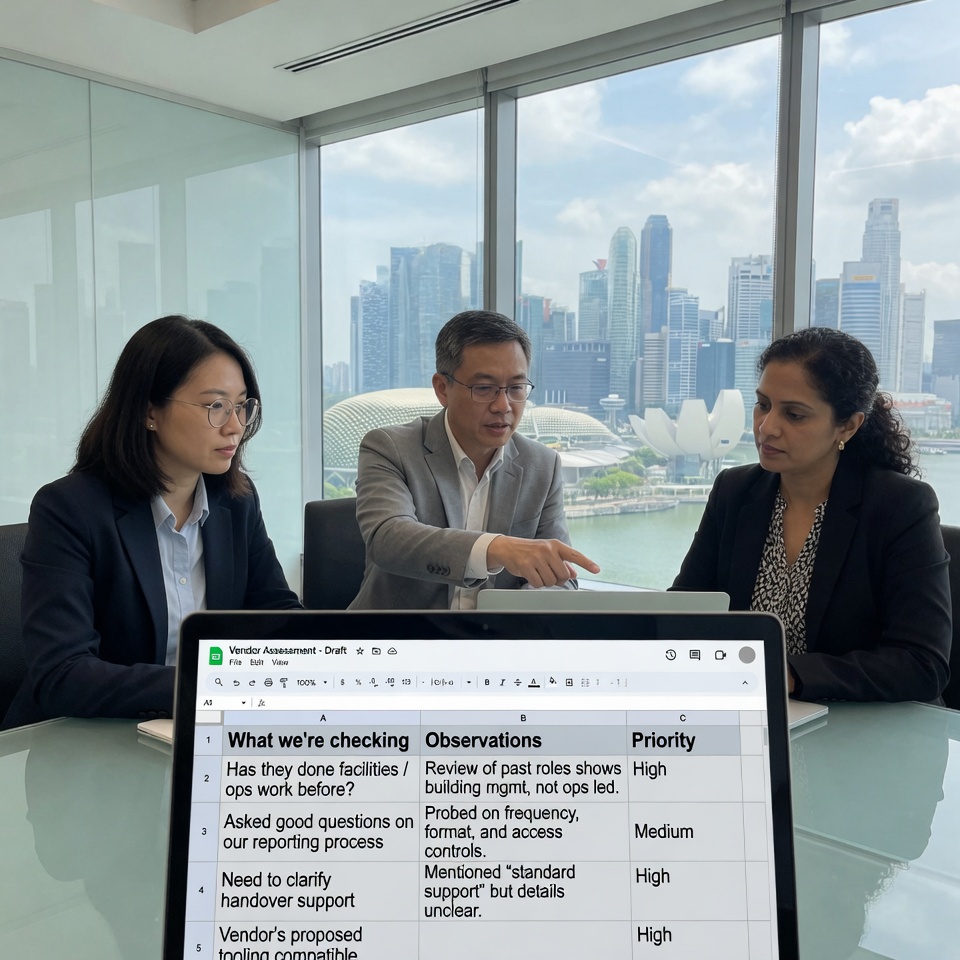
A practical vetting framework decision-makers can use internally
When shortlisting a data analytics consultant in Singapore, credentials alone won’t protect you from a poor fit. A simple internal framework helps cut through the noise:
- Industry relevance: Have they worked in environments similar to yours, or are the examples high-level and abstract? Familiarity with your operating reality matters more than brand names.
- Business problem framing: Do they restate your challenge in clearer terms—or jump straight to solutions? The best consultants improve the question before answering it.
- Data maturity alignment: Watch how they react when you describe messy data. Experienced teams adapt. Inexperienced ones promise perfection.
- Change management capability: Insights don’t implement themselves. Ask how they’ve handled resistance, training, or handovers in past projects.
- Post-deployment ownership: Clarify what happens after delivery. Support, iteration, and accountability are where many engagements quietly fail.
Which questions to ask that reveal real experience versus polished credentials
Instead of asking for case studies, ask what went wrong in past projects and how they adjusted.
One useful question is: “What would you do differently if this engagement underdelivers in the first 90 days?”
Real practitioners answer concretely. Surface-level sellers stay vague.
How can you tell if a consultant’s methodology will work in your organisation—not just on paper?
An increasing number of organisations in Singapore are running hybrid environments of modern cloud-based tools and legacy systems that support core business processes. The methodology outlined on paper for managing the data analytics work often fails to translate in real life when dealing with such complexities. A more realistic way to approach how to adjust your methodology for your organisation is to list out the components of your current methodology and then, for each one of them, rate how “usably” you currently are using that component with your organisation right now. That means that some of the things that you currently are using will be “ugly” – that means they are not ideal, but they are workable right now, and that means they are usably workable for your organisation. Others will be things that are not workable yet, but you anticipate they will be in the future.
Sequencing what to “fix” first and then what to a good data analytics consultant works within the constraints that are in place and answers two key questions: 1) What won’t change in the next 6 months and 2) How can you work within these constraints. A consultant who does not answer these questions completely will not be a good fit for your organisation. Pay attention to how they explain things. If methodology seems easy to explain when it should be complex and detailed, then that person likely has lots of real-world experience with it.
What role does local Singapore context play in successful analytics consulting engagements?
The local Singapore context adds a layer of complexity in data analytics consulting that many global methodologies are not able to address. For example, in very regulated industries or traditional ones, the data may be housed on systems where access is controlled and approved by others, and where there is some delay in approving data access. The operations teams who use data to perform their work are often also under extreme pressure to meet performance metrics, as well as comply with a variety of laws and regulations. The impact of data access can therefore be further affected by multi-layered approval processes across IT, compliance, and regional HQ teams, each with their own approval processes and timelines.
Local context also affects timelines. Public holidays, the deliverables and timing of external vendors, and reporting by organisations from around the world can all affect a consultant’s ability to meet their deliverables on time. It is how early a consultant can identify potential problems and work to resolve them that truly matters. Being on the ground helps a consultant understand the internal politics of an organisation, adjust their communication with stakeholders based on their goals and styles, and anticipate potential resistance and roadblocks early on. This awareness of potential points of friction does not mean that they will occur. However, they will occur at a different point and can be addressed earlier.
How should decision-makers compare shortlisted data analytics consultants before making a final call?
For the small details that don’t really matter at the end of the day, small signals matter more than the perfectly polished deck that you had for the presentation. One late-stage red flag is overconfidence. No experienced team paints an overly rosy scenario of success without outlining the trade-offs and risks involved.
As a rule of thumb, most experienced teams are cautious in painting overly rosy success stories in their presentations. There are two aspects you need to test: one is the consultants’ claims about past projects. Rather than them referring you to past projects that worked, put them on the spot and really pressure test their claims by saying something like: “Okay, so you did this project, and that project was not successful; describe it to me and then describe how things changed and what happened afterwards.
Before you hire a data analytics team, do a simple sanity check: “Do we trust this team to tell us hard truths when things go off plan?” The right data analytics consultant in Singapore is someone you want in the room when uncomfortable questions start about your assumptions.