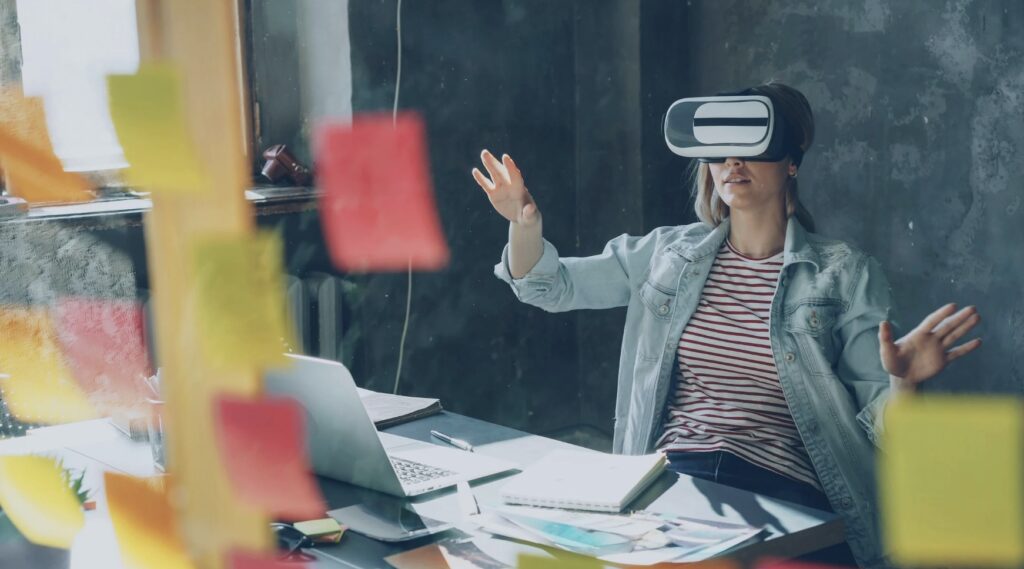
Imagine you put on a headset, and you will no longer be in a classroom or a meeting room. You will feel as if inside a chemical plant during a gas leak, or standing at the front of a boardroom about to give a difficult presentation. That, in a sentence, is why VR training is gaining popularity: it lets people practise things that are too risky, too expensive, or too awkward to practise in real life.
In Singapore, both schools and companies are investing in it. This guide covers what VR training actually involves, how it’s being used here, what it costs, and how to decide whether it’s right for you.
What VR Training Actually Is
VR training uses a headset to place learners inside a simulated environment where they can look around, move, and interact with what they see. Unlike a video, it responds to what the learner does. Make the wrong call during a simulated fire, and the fire spreads.
Most programmes fall into three groups. Skills practice lets people rehearse physical procedures, from operating machinery to drawing blood. Scenario training puts people in situations that would be dangerous or costly to stage, like an evacuation or an equipment failure. And soft-skills training simulates human interactions: handling an upset customer, running an interview, speaking to a crowd.
How Schools and Institutions in Singapore Use It
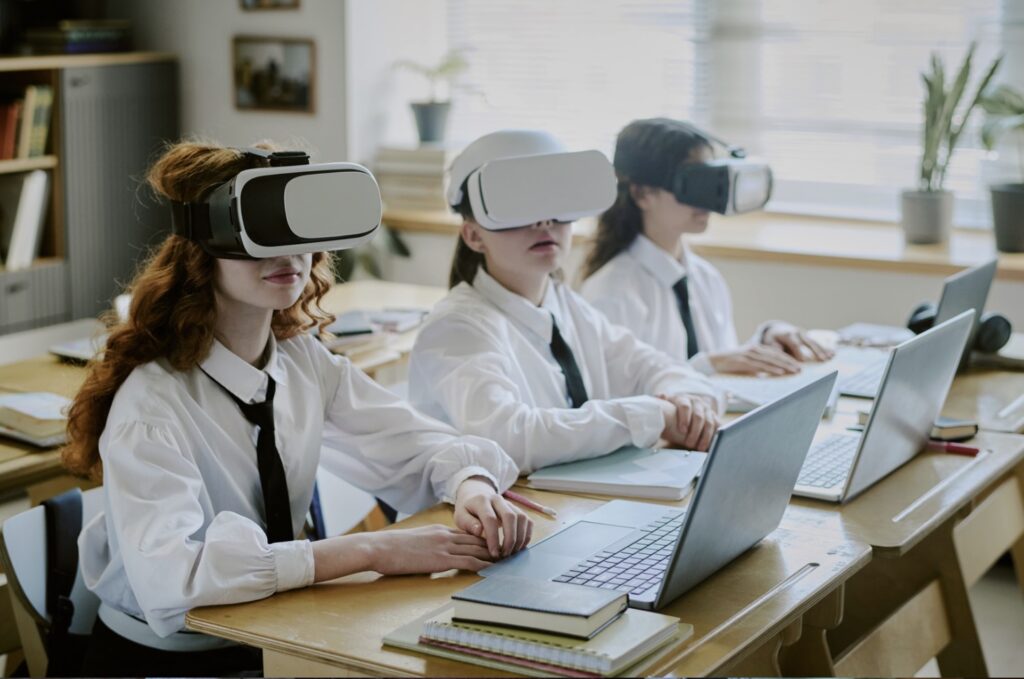
In education, VR works best when it makes the students see things that are invisible. A secondary school science class can walk through a cell instead of squinting at a small diagram. In a history lesson, students can stand inside a street scene rather than just read about it.
In higher education, this technology goes further. Nursing and allied health students can rehearse clinical procedures on virtual patients before touching real ones. Engineering students at polytechnics and ITE can practise on equipment that would be too expensive to let every student handle. Similarly, aviation and maritime courses, both big industries here, have used simulation for decades; VR simply makes it cheaper and more portable.
The common thread among all this is that education uses VR to build understanding. Students are allowed to explore, make mistakes, and take their time. The experience doesn’t need to be efficient; it needs to make ideas stick.
How Singapore Companies Use It
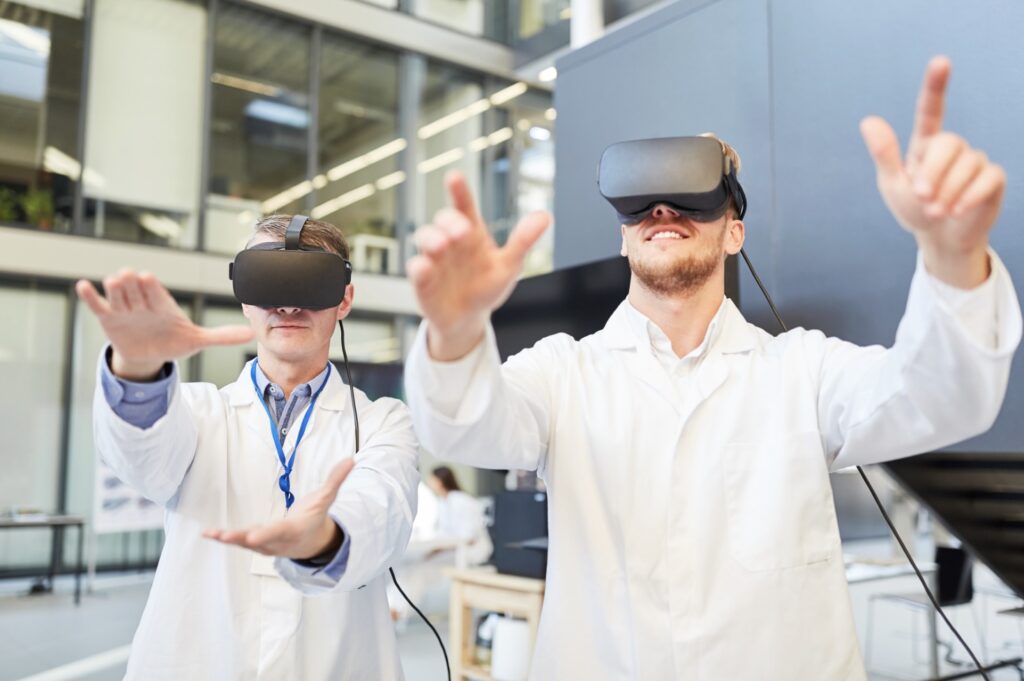
Corporate training has a different job. Employers need people to perform, so that there are fewer mistakes, faster onboarding, and better safety records. So workplace VR tends to be more structured, with clear pass-fail outcomes.
The strongest use cases in Singapore right now are workplace safety and hazard training for construction, manufacturing and logistics, where letting someone experience a fall or a forklift accident virtually beats any poster campaign. Onboarding is another, especially for frontline and technical roles where new hires can practise before their first real shift. And soft-skills training is growing fast, because rehearsing a retrenchment conversation or a sales pitch with a virtual human is far less painful than practising on a real one.
One thing worth knowing before you buy: a corporate VR module only changes behaviour if it forces decisions and shows consequences. A beautiful walkthrough that asks nothing of the learner will be enjoyed, completed, and forgotten.
What VR Training Costs
This is usually the first question, so here are honest numbers.
Standalone headsets like the Meta Quest range cost roughly S$500 to S$800 each, and they no longer need a powerful PC to run. A classroom or department set of ten is a five-figure purchase, not six.
Content is where budgets vary. Off-the-shelf training libraries can be licensed per user per year at relatively low cost, and they’re fine for generic topics like workplace safety basics. Custom-built simulations, designed around your specific equipment, site or procedures, typically start around the low tens of thousands and climb with complexity. A full multi-scenario simulation with tracking and analytics can reach six figures.
The good news for Singapore buyers: many structured VR training courses are SkillsFuture-claimable, and various government grants support companies adopting digital training tools. Check the current schemes before you budget, because they change, but don’t assume you’re paying the sticker price alone.
How to Get Started
Whether you’re a school or a company, the path looks similar.
Start with one problem, not a programme. Pick a single topic where current training clearly falls short, something hands-on, high-risk, or hard to visualise. That’s where VR shows its value fastest.
Run a small pilot. A handful of headsets, one module, one cohort. Measure something real: test scores, error rates, time to competency, not just whether people enjoyed it.
Plan what happens around the headset. VR works when it’s wrapped in ordinary teaching: a briefing before, a discussion after, and a refresher later. Dropped into a timetable with no context, even good content fades quickly.
Then decide whether to build or buy. If your needs are generic, license existing content. If your training depends on your specific site, syllabus or procedures, work with a local developer, and ask them hard questions: What will learners actually do in the simulation? How will results be measured? Who handles the devices and updates?
When Not to Use VR
A complete guide should say this plainly: some training doesn’t need VR. Theory-heavy topics, simple compliance content, and anything that works fine as a conversation will not improve inside a headset, and a well-run workshop will beat a mediocre simulation every time. VR earns its cost where practice matters and real practice is hard to get. Everywhere else, save your money.
The Bottom Line
Effective VR training in Singapore has moved past the gimmick stage. The hardware is affordable, local developers are experienced, and funding support exists. What separates the programmes that work from the ones that gather dust isn’t the technology. It’s choosing the right problem, designing for your audience, and treating VR as part of your training system rather than a bolt-on. Get those right, and the headset is the easy part.
Frequently Asked Questions
Is VR training effective?
Yes, for the right topics. Studies consistently show better retention and confidence for hands-on and scenario-based learning. For pure theory, the gains are small.
Can VR learners get motion sickness?
Some do, especially in experiences with lots of artificial movement. Well-designed training keeps movement natural, and sessions short, usually 10 to 20 minutes.
How many headsets do we need?
Fewer than you think. Most schools and companies rotate small groups through stations rather than equipping everyone at once.
How is VR used differently in education and corporate training?
Education focuses on exploration and understanding, while corporate training prioritises measurable performance outcomes.
Is VR effective for employee onboarding?
It can significantly improve engagement and retention when designed around decision-based scenarios.
What industries benefit most from corporate VR training?
Healthcare, manufacturing, logistics, and aviation are leading adopters.